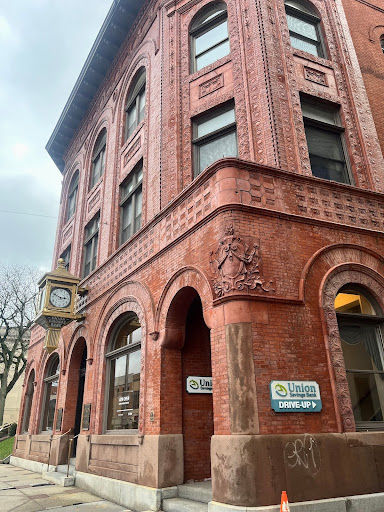
This is a picture of a bank built in 1866 in Danbury, Conn.
Compare that to a modern bank, say, your local M&T or Wells Fargo. Perhaps those modern buildings are more practical and efficient, but I cannot stroll past a brick building like this Danbury bank and not appreciate its charm with its rows of lined brick with a golden clock and adorned arches above the windows.
Someone might bring up the obvious point that buildings like this cost more to create in materials and design. They might say that affordable architecture that prioritizes sustainability and efficiency instead of beauty makes those practical buildings worth more in the long run. Yet as someone who knows nothing about architecture I still have to ask myself, if money is the main issue then why do so many buildings owned or created by people with money look so ugly?
I suppose if someone has to mass construct a thousand Walmarts with the sole purpose of making money, it makes sense to cut corners, especially for energy efficiency and material durability.
You can see this contrast clearly at universities in the New Haven region. Yale University, a prestigious Ivy league with a tiny acceptance rate and beautiful campus was built 300 years ago. Now take Southern Connecticut State University, a state college with an arguably modern-looking campus, although it was founded over 100 years ago.
Both are good schools, but any person on the street would tell you Yale is the better school in prestige, influence and higher learning. The campus looks like castle grounds, not only reflecting its historical uniqueness but also its exclusivity and status. We associate good-looking architecture with good things. Southern still looks neat, but they don’t have a medieval courtyard.
I’m not going to pretend there aren’t drawbacks to traditional architecture. It is known that old buildings like the ones at Yale are not very accessible. Some buildings have elevators but they are usually out of order. The sprawling campus is extremely difficult to navigate for those with mobility issues and many facilities are without any accessible entry points. It is apparent that three hundred years ago when Yale was founded they were not perhaps concerned with people who are disabled.
Old buildings simply require a level of maintenance that new buildings do not require. Aging structures require time and investment that many people aren’t able to keep up with, especially when the process itself of renovation opens up a can of worms including energy performance, outdated codes and faculty electrical issues. Beautiful charm and historic significance end up being sacrificed for higher energy efficiency and more modern functionality in this costly exchange.
My argument for structures looking pretty stems from the fact that we tend to be happier when our environment is pleasant. A study at the University of Oxford found that even though happy employees do not generally work more hours than employees who are less happy, they are more productive within those hours.
If a corporation wants to maximize profit it can construct cheap working spaces for employees and focus on other aspects of making money. Now imagine if the corporation spent time and money to design and create a beautiful working space with glistening hanging lights and ornate rugs, painted arches and wooden doors. This would no doubt be more costly to the corporation, yet I would argue that the employees would become happier while working.
When they are happier, they are more productive. When employees are more productive then they do their job better and still make the corporation more money. An article at Forbes magazine maintains that quality working environments and more comfortable atmospheres provide the space for better work to be completed.
The cohesive argument against old structures is that they are costly to maintain. If you change an aspect of a historically significant window, is that ruining it? What if the window is faulty and provides either too much or not enough ventilation? Energy efficiency can be maintained in old buildings with care and money. On the flip side, some studies show that historic buildings often are more energy efficient than some modern buildings. Thick heat retaining walls as well as the fact that homes made better use of natural light sources and ventilation before electricity existed all contribute to this.
America has a lot of different styles of architecture – ranch, farmhouse, colonial, craftsman and that’s just residential styles alone. Combined with religious architecture, immigrant styles from Europe and elsewhere prove that this country does indeed have a rich architectural history. Loss of architectural identity can in part be traced back to lack of regionalism in housing developments. In other words different places create general styles of buildings that are not specific to any one region or culture.
This creates a formula for housing development that combines little to no innovation and a desire to cut corners financially. This results in many places looking identical despite them being across the country. You can travel to Virginia or Oregon and you’re likely to find a similar looking shopping plaza nearby and streets that very much look alike.
Architecture and how our world looks can represent our cultural values and moral beliefs, and culture in return shapes the meaning and purposes of buildings. If our world is declining in visual uniqueness and color, what does that say about our society as a whole? Is it a form of cultural decay?
I hope that we can continue to use the beautifully designed blueprints that created such charm long ago and still combine them with the need for affordability and practical spaces the modern world requires. I am tired of walking through bleak urban scenes full of gray buildings with endless right angles. I’m tired of looking at buildings with shiny windows in rows that blind me with their monotonous flat stories that tell me nothing about what kind of building it is.
At the same time, I am tired of old buildings with crumbling foundations and toxic decaying chemicals. I know there has to be a middle ground where artistically appealing structures can be made more often instead of creating a skyline that’s made with the least amount of innovation.
So let’s return to my picture, the simple brick Danbury bank. It’s quiet, it’s not as recognizable as a Chase Bank on a main road. However, there is something to say about its structure and form, the history it tells, and the culture it promotes. It feels durable, more interesting and credible.
Sure, the world is different now and we might not need to adopt the same styles, but that doesn’t mean that every highway overpass needs to be the same. I long for a world that’s colorful, not only in architecture but in mind and soul. I long for a world with intentional design and artistic prowess.
I long for a time when buildings looked pretty.






Comments